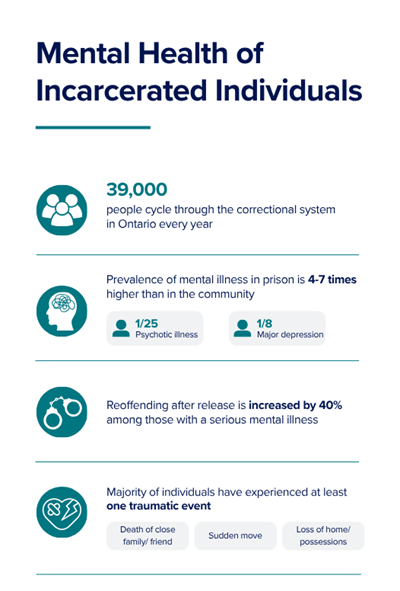
People with serious mental illness are significantly overrepresented in correctional settings, with prevalence rates estimated to be up to four to seven times higher than in the general population. Research shows that about 15 per cent of people in custody have a serious mental illness, and approximately 50-60 per cent have a substance use disorder.
These challenges rarely exist in isolation. Many individuals also face homelessness, poverty, lack of service access, and stigma—all of which can make recovery more difficult and increase the risk of reincarceration.
At the Centre for Addiction and Mental Health (CAMH), the Forensic Psychiatry Division aims to change this paradigm and shape the future of forensic care. The specialized program provides comprehensive care and services for people with serious forms of mental illness who have come into contact with the law, bringing together scientists, stakeholders, and multi-disciplinary partners from across Ontario.
“Our mission is to advance knowledge of risk, recovery, and treatment of people with criminal justice system involvement and mental illness, as well as the biological, psychological, and social underpinnings that inform prevention, intervention efforts, reduce stigma, and minimize risks to public safety,“ says Dr. Treena Wilkie, Chief of Forensic Psychiatry.
The Forensic Early Intervention Service (FEIS)
One of the Forensic Psychiatry Division’s initiatives is the Forensic Early Intervention Service (FEIS), a partnership between the Ministry of the Solicitor General, the Ministry of Health and Long-Term Care, and CAMH.
Consisting of a multidisciplinary team including social workers, occupational therapists, nurses, and psychiatrists, FEIS provides specialized mental health assessment, triage, and case management for people whose illness may affect their ability to participate in the legal process at two major correctional facilities within the Greater Toronto Area (Toronto South Detention Centre and the Vanier Centre for Women). The service has seen a significant increase in demand year over year and assists close to 4,000 individuals with serious mental illness each year.
“Many people with mental illness do not have their needs met in traditional prison-based mental health services,“ explains Dr. Sandy Simpson, Senior Scientist in the Forensic Psychiatry Division, Professor of Forensic Psychiatry Research, and a FEIS psychiatrist. “FEIS is crucial because it helps identify and support people early—often during an acute crisis—before they deteriorate further in custody or become more deeply entrenched in the justice system. By connecting people to timely psychiatric care and supports, we can improve health outcomes and enhance public safety.“
Continuation of Care Following Release
For many individuals, the most vulnerable moment is upon release. Individuals can be released precipitously, often without identification, housing or a connection to a family doctor or psychiatrist.
Without rapid access to care, reoffending after release is increased by 40% among those with a serious mental illness. Individuals with schizophrenia spectrum disorders, major depressive disorder, and bipolar affective disorder are at especially high risk of reincarceration.
CAMH’s innovative community reintegration service aims to fill this gap. Building on the existing FEIS, the short-term bridging service provides immediate access to mental healthcare on release to ensure continuity of care as individuals transition into the community.
The program typically lasts up to four months and focuses on practical, urgent needs such as:
- Accessing continued psychiatric care and medication
- Accessing housing
- Obtaining identification documents and applying for welfare benefits
- Obtaining primary care
A pilot of the service started accepting patients in January 2024 and has since received over 100 referrals and assisted 38 individuals with their transition into the community. Most did not have identification documents, including health cards, access to primary care, or had experienced long-term homelessness before incarceration. Thanks to the FEIS Community team (FCT), the majority of individuals have received basic startup items such as toiletries or clothing, have obtained financial support through the Ontario Disability Support Program or Ontario Works, and have been connected with legal supports. A significant number have also reconnected with friends and family or joined support and social groups.
“I was incarcerated for three years and do not have any family in Canada or back home. My FEIS case manager referred me to FCT. Once released, I went with the FEIS social worker to the boarding home where I was expected. I now have room and board. Before being in jail, I was homeless for four years. FCT helped me with my health card, birth certificate, and landing papers. I finally have a place, which is my home. FCT became my friends, my family. I take medication and I am doing well. On my birthday, staff at the boarding home bought a cake for me. It was so nice,“ says an anonymous participant about the real-world impact of the pilot project.
Looking Ahead
Programs like FEIS and the FEIS community service demonstrate that with the right supports, people can stabilize, reconnect, and move forward. Building on the success of the initial pilot, the team is now planning to expand these services by exploring potential collaborations, increasing education within correctional facilities and with community providers, and evaluating the economic impact and cost effectiveness of the program.
“The period immediately following release from custody is one of the most vulnerable times for people living with serious mental illnesses. The FEIS community service is helping to bridge that gap by providing practical support, psychiatric care, and connecting people with services as they transition back into the community. It has been very rewarding to see many individuals who were once repeatedly returning to custody establish stable housing, engage with treatment, and reconnect with family,“ says Dr. Roland Jones, Scientist in the Forensic Psychiatry Division and Medical Head of FEIS.
Learn more about the Forensic Psychiatry Division at CAMH here.